João V (1689 – 1750), son of Peter II and his second wife Mary II of Savoy.
In 1700, following the death of Charles II of Spain without a direct heir, which caused political instability among various European countries with the Archduke of Austria and Philip of Anjou—grandson of the French king Louis XIV and member of the French royal family—both laying claim to the throne, Portugal broke off its good relations with France. In 1703, it recognised and supported Charles of Austria as the heir to the Spanish throne, thereby creating an Anglo-Portuguese-German alliance.
The Archduke of Austria arrived in Lisbon on 9 March 1704 for the purpose of seizing the Spanish throne, being supported by a British squadron.
After various political disagreements and wars, the issue of succession in Spain was resolved in favour of Philip V, who kept the Spanish crown (1700-1746) and its respective colonies, but renounced the right of succession to the French throne. The negotiations leading to the signing of this treaty began in 1712, with Portugal being represented in them by the Count of Tarouca, João Gomes da Silva, and D. Luís da Cunha. In 1713, Portugal's sovereignty over Brazilian lands comprising the Amazon and Oiapoque rivers was recognised.
In 1715, it was agreed to restore the colony of Sacramento to the Portuguese.
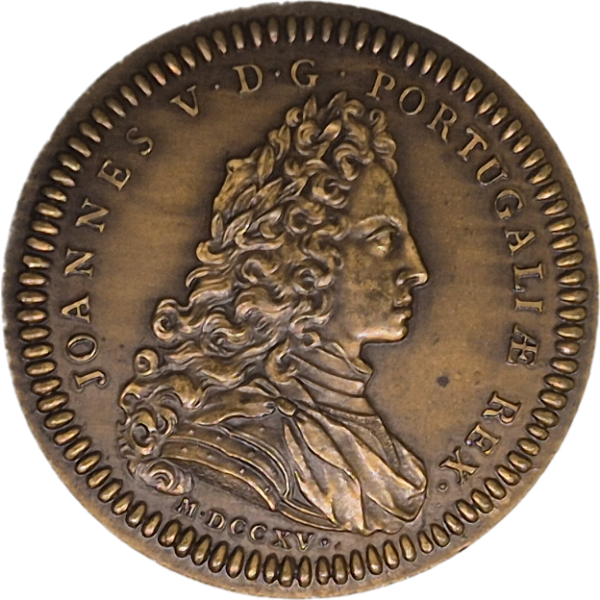
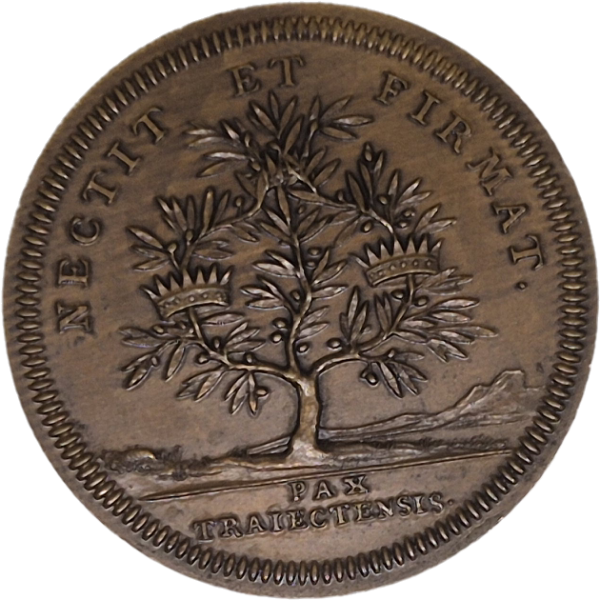
This medal commemorates the event of the Treaty of Utrecht, where two crowns together (Portugal and France) can be observed on the same tree, as part of the same family.
Reverse of the medal: Joannes V, by the grace of God, King of Portugal.
Reverse of the medal: Nectit ET Firmat – Pax Traiectensis